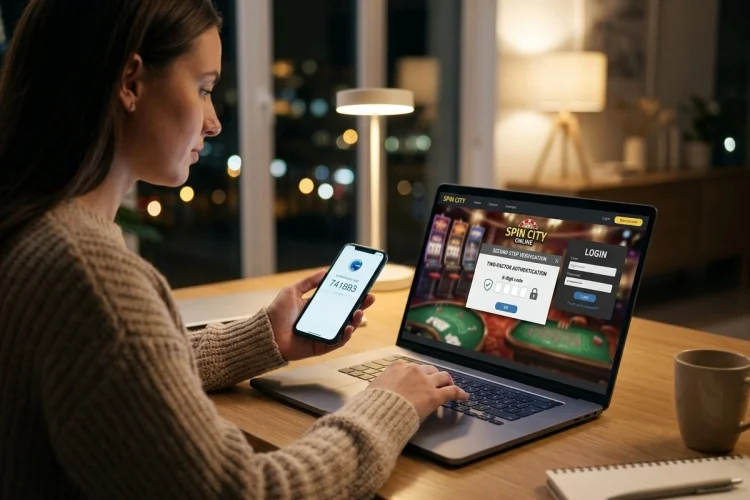
A password may be the first barrier protecting an online casino account, but relying on one password alone can create unnecessary risk. Passwords can be reused, exposed in data breaches, guessed, or stolen through phishing.
Two-Factor Authentication at Online Casinos adds another verification step before account access is granted. Depending on the casino, that second factor might be a one-time code, authenticator app, device prompt, or security key.
Understanding how this technology works can help players make better decisions about protecting balances, payment details, and personal information.
What Is Two-Factor Authentication?
Two-factor authentication, commonly shortened to 2FA, is a security method that requires two different types of evidence before a user can access an account.
A password is normally the first factor. The second comes from another category, such as something the user possesses or something linked to their physical identity.
OWASP explains that multi-factor authentication can combine factors such as something you know, something you have, and something you are. Simply requiring both a password and PIN does not normally count as true MFA because both belong to the same knowledge category.
In simple terms, knowing a casino password should not automatically be enough to enter an account when 2FA is enabled.
How 2FA Works During a Casino Login
Imagine that a player enters an email address and password into an online casino.
Without additional authentication, a correct password might be enough to complete the login. With 2FA enabled, the system requests a second form of verification.
For example, the casino might ask for a six-digit code generated by an authenticator app. That code changes frequently and normally works only for a limited period.
The player enters the code and, if both factors are accepted, access is granted.
This creates two barriers. An attacker who steals the password would also need access to the second authentcation factor.
Why Passwords Alone Can Be Risky
Passwords remain useful, but they have several weaknesses.
People sometimes reuse the same credentials across shopping sites, social networks, email accounts, and gaming platforms. If one website experiences a data breach, criminals can test those leaked username-password combinations elsewhere.
This technique is known as credential stuffing.
OWASP identifies MFA as one of the strongest defenses against credential stuffing, password spraying, and many other password-related attacks.
For a casino player, that additional protection can matter because an account may contain more than entertainment funds. It could also include transaction history, contact information, identity verification details, and saved account preferences.
What Types of Second Factors Are Available?
Several technologies can provide the second authentication factor.
1. SMS verification codes
Some services send a temporary code through a text message. The player receives the code and enters it after submitting a password.
SMS is convenient and generally provides more protection than using a password alone. However, it has weaknesses, including phishing and attacks involving compromised phone numbers.
NIST notes that one-time PINs and SMS-based authentication can still be vulnerable to phishing and recommends stronger phishing-resistant approaches where available.
2. Authenticator apps
Authenticator apps can generate time-based one-time passwords, often called TOTP codes.
These codes can usually be generated even when the phone has no mobile signal. The secret used to generate them remains connected to the authenticator setup rather than being delivered through a normal SMS channel.
OWASP recommends providing TOTP-based MFA as a widely applicable option for web applications.
3. Security keys and passkeys
Physical security keys and modern passkeys can provide stronger protection against phishing.
Instead of asking users to manually type a temporary code into a potentially fraudulent page, these systems use cryptographic authentication tied to the legitimate website.
NIST identifies FIDO-based authentication as a widely available phishing-resistant approach.
How 2FA Helps Protect Casino Balances
Consider a simple example.
A criminal obtains a player’s casino email and password through an unrelated data breach. They attempt to sign in and find that the password works.
If 2FA is disabled, the account could potentially be exposed immediately.
If authenticator-based verification is enabled, the attacker faces another barrier. They still need the temporary code or authentication device controlled by the actual user.
This does not make an account impossible to compromise, but it significantly improves protection against common password-only attacks.
The same principle can be useful for other sensitive actions when a platform supports additional verification, such as changing account details or security settings.
Why Sensitive Changes May Need Extra Verification
Login is not the only point where additional authentication can matter.
Imagine someone gains temporary access to an already authenticated browser session. They might attempt to change the email address, reset security information, or disable 2FA.
OWASP recommends additional authentication for high-risk actions such as changing passwords, changing account email addresses, disabling MFA, or replacing existing authentication factors.
This practice is often called step-up authentication.
Instead of assuming that an existing session is enough, the service asks the user to prove their identity again before allowing an important change.
Can Two-Factor Authentication Be Phished?
Yes, some forms can.
A fake casino login page could ask for both a password and a one-time verification code. If the attacker forwards those credentials quickly enough to the genuine website, they may be able to use them before the temporary code expires.
This is why users should never assume that every request for a 2FA code is legitimate.
Check the domain before entering credentials and avoid opening login pages through unexpected emails or messages.
Phishing-resistant approaches such as FIDO security keys and passkeys provide stronger protection because authentication is cryptographically connected to the legitimate website rather than relying on a code users manually type.
What Happens If You Lose Your Phone?
Losing access to a second factor can create its own problem.
For this reason, services may provide recovery codes, alternative factors, or an account recovery procedure. Google, for example, recommends storing backup codes securely so users can regain access when their normal second step is unavailable.
If an online casino provides recovery codes, they should be stored somewhere seperate from the device used for normal authentication.
Do not send backup codes through public messages or save them in an unprotected document that others can easily access.
Account recovery deserves serious attention because weak recovery procedures can undermine otherwise strong 2FA.
2FA Does Not Replace a Strong Password
Two-factor authentication should supplement good password security rather than replace it.
Players should still use a unique password for their casino account instead of recycling one already used for email, banking, or social media.
A password manager can make unique credentials easier to maintain.
Players should also pay attention to unexpected login notifcations. If a 2FA request appears when you are not trying to sign in, someone may already know your password.
In that situation, reject the request when possible and change the affected password through the legitimate website.
Two-Factor Authentication at Online Casinos adds an important barrier between a stolen password and an account. Authenticator apps, security keys, passkeys, and even SMS can provide additional protection, although some methods are stronger than others.
If your casino offers 2FA, review its available methods, secure your recovery options, and combine authentication with a unique password and careful phishing awareness.